Back
to Shop Made Tools
Designing
a Bench
I
did not intend writing articles on building a bench. However, I asked
a few questions on a couple of forums, and it snowballed. Below is an
attempt to pull these together into something coherent.
My
existing bench is 18 years old, has been modified many times over the
years to keep pace with my changing approach to woodwork, and is
showing its years. It is small - about 4'10" long. It is too
wide - about 26". The top has been planed down so many times
that the dowels I used to orientate the boards all those years ago
are now showing half their thickness. Although the legs are spindly,
the bench is really rigid as it is bolted to the wall (the new bench
will be placed about 2 ft from the wall). The Record 52 1/2 vises are
now hopeless. The front vise racks and the tail vise does not open
unless you hold down the release lever while you turn the handle. And
it is too dark. The Karri top may look exotic in pictures, but it
does not reflect light well.

The
bench has been a good friend but I still find it amazing that I
managed to do so much work on it. I procrastinated and avoided
building another as I generally dislike building shop furniture. Or
using good wood that would better be used on furniture for the home.
But now it is time for a new bench, a better bench.
I
like the simplicity of a Roubo. I thank Chris Schwarz for his
research and the information he disseminated. It has been
educational.
Since
building a Moxon vise (for dovetailing) a year ago I have come to
recognise that my face vise needs (for planing edges) would now be
best met by a leg vise. I plan to build one with a wooden screw (a
most kind gift of Wilbur Pan), while the tail vise is a Benchcrafted
wagon vise.
Generally I try and build as much as I can from
recycled timber. I find a lot of old Jarrah roof trusses. These are
dry and hard. They will be turned into the base.
Today I dug
out the rafters that I thought would work best. These are 3"- 3
1/2" x 4"- 4 1/2" and around 80" long. I should
be able to get four legs at 3" x 5". I am aiming for a 34"
high bench.

The
top is to be 4" thick, 21-22" wide and 6 ft long, built
from European Oak (which
means
it likely originated from Eastern Europe). One of the members of my
local ww club bought a shipment imported by a failed business, and
was selling it at a cheaper price than the local Tasmanian Oak, which
lacks its stability and texture. This was jointed and thicknessed for
me, and has been "acclimatizing" (aka lying around) for
several months. There has been minimal movement.


Two
boxes at the top ... BenchCrafted tail vise and woodscrew ...

My
intention is to build a wooden replica of the steel screw leg vise
designed by BenchCrafted.
Building
the legs
I
began preparing the stock for the legs yesterday afternoon, that is,
finding boards in my wood pile for laminating into the desired 5"
x 3" size. There were issues with the stock I have.
As I
showed earlier, I have a number of rough sawn rafters approximately
3" x 4". Once jointed it became evident that only 2 legs
could be created from two boards, and that the other 2 legs would
require laminating 3 boards.
The two-board laminations would
have to be joined edge-to-edge, and the three-board laminations not
only joined edge-to-edge but include a face board to increase the
thickness.

A
central mortice would occur at the join. Not happy.
It is now
Sunday. We spent the morning at the beach. This gave me a chance to
switch off and think about the options. A little lateral thinking
gave me the answer.
Choices ...
Firstly, I could go out
and purchase Jarrah boards to make the legs. There a couple of
reasons why I do not do so. It is not simply that these would be
expensive. Expensive? Very! I estimate that each leg would end up
costing about $125. That is about $500 for the legs, and we have not
yet got to the stretchers.
Why is Jarrah (Eucalyptus
Marginata) so expensive? Because it has been over-logged in Western
Australia for over 100 years, with the timber being exported around
the world for bridges and roads. The trees only grow in Western
Australia - no where else - and the forests have been decimated. The
logging continues, in spite of the frequent protests from the Greens,
because the public generally places money above the environment. I
really do not wish to support this industry, and 90% of the Jarrah I
use comes from salvage - old roof beams, old flooring, etc. Some from
the renovations in our house (all the roof beams are rough sawn
Jarrah), and some from skips (dumpsters) when houses are demolished
(but now there are businesses buying up the old timber - that's OK
with me. At least it gets a second life, and I will - and do -
happily purchase that).
Secondly, let us not forget the most
important factor here - this is a workbench, not a piece of furniture
for the home! Yes, I would like to build a bench that is as faithful
to the principles of Roubo, and guided by the recommendations of my
friends on the forum, but it is still just a bench. Anything I do
will be totally overkill compared to the bench I have been using for
the past 18 years. I must add that, prior to the current bench
(skinny cretin that it is ), my previous "bench" was a door
over trestles. This lasted 7 years while we lived in and restored our
previous house. So I have had 25 years working with poor benches. I
do believe that anything better than I had will last another 25
years, at least.
So
... I thought about what I had to work with, what wood I had on the
rack, and hatched the following plan which I shall describe, and then
go off and cut the parts to show you later ..
The solution is
... may be - I will hear from you I hope ... to create a sandwich
with full width boards on the outside. Inside, the two sections I
previously showed will be used, BUT one piece will be recut to
sandwich a thick section which is centred in the fill. Now a mortice
can be created in solid, un-edge-joined timber.
Since the
added laminated with be about 3/4" thick each, I anticipate that
the legs end up about 5" long x 4" thick.
Fast
forward about 5 hours ...
As I mentioned in an earlier post, I
try and re-use reclaimed timber. Here is an example. Woolly and
twisted ...

One
side gets jointed then, because the thickness of the other side is so
uneven, I use the bandsaw to cut to the approximate thickness before
planing out the saw marks ...

The
Jarrah "infill" was ripped to width on the tablesaw. There
is now enough meat in the centre of each leg to accept a mortice
...

The
wooden screw for the leg vise has a 2" diameter. This will
easily fit into the 3" central section in these legs ..

The
legs are yet to be glued up. Once done, final dimensioning will be
done. The sides (end grain) could be stained to match the fronts. Or
I am toying with the idea of mitering and wrapping boards around the
infill.

The
legs are now 5" wide and 3 5/8" thick.
Each leg
weighs 10 kg (22 lbs).
The bench top is expected to weigh 80
kg (172 lbs).
Still to add in stretchers, chop, and end vise.
One
Change Leads To Another
I
was asked why I chose the Benchcraft tail vise.
The choice of
tail vise was made on a number of factors, one of which was the space
available for the bench. My bench is placed against a rear wall in my
garage/shop. The length of the bench is limited by a cabinet, to the
left, and a door, to the right. It comes down to the longer the
bench, the shorter the tail vise ... or, the longer the tail vise,
the shorter the bench.
The
Benchcraft tail vise is notable in that the handle remains in one
position, that is, does not "screw out" or "screw in"
in length. This translates into a short vise, which means I can build
a longer bench. The bench size increases from a little under 5' to a
little over 6'. This may not sound a lot, but it is a massive change
for me.
I was initially planning on building my own version of
the Benchcraft wagon vise. However, when Chris Vesper visited with me
last year, he mentioned that he had purchased the BC tail vise. When
I asked why he had not simply built his own - since he is a top class
machinist - he explained that the design of the vise places great
stresses on the mechanism (it screws at the side of the captured dog
so as to run close to the edge of the bench), and that to accommodate
this, the steel work needed to be heavy duty ... and that the BC was
built like the proverbial tank. He did not believe he could replicate
it. That sold me on the BC for the tail vise.
I hope to get to
the bench dogs tomorrow. These will be rectangular, not round, so I
have to prepare them before I glue up the bench top. Why rectangular?
Simply because I believe that they will hold work more securely than
round dogs. They have a broader face and will not twist. Plus, I
wonder how many bench (dog) builders realise that the dogs need to
incline slightly (I am using 2 degrees) towards the work piece? This
is difficult to do if drilling for a round dog. Yes, it is possible
to cut and angle a flat upper section of a round dog, but this thins
and potentially weakens the dog, making it more susceptible to
bending under stress. A rectangular dog is more work, both in
planning and build, but it worth it. This does not preclude one from
adding holes for bench accessories, such as hold downs.
So
today I plan to finish off the legs. Their dimensions are 5"
wide and 3 5/8" deep. I have cut the tenons, and what is left is
to prepare one for the leg vise and all for the mortices for the
adjoining stretchers. While I will not complete the base until after
the top is done (as the length of the stretchers is determined by the
dimensions of the top since all facing edges will be co-planar), I
need to have everything ready to receive the top once it is glued up
just so that I can work on the top.
To decide the length of
the legs I first had to finalise the height of the bench. The present
bench, which I built 18 years ago, was a remnant from a pre-handtool
era. Much modified over the years to better deal with the demands of
handtools, it still retained that one feature of the powertool user -
height. It is 34" high. Too high for comfortable handplaning at
my 178cm/5'10".
Chris Schwarz recommends the "pinky
test", that is, the height of the bench should be situated where
your pinky joins your hand when your arm is held at your side. I did
this and the result was a bench height of 30". To test this out
I place a double layer of bricks in front of the bench, and planed a
board while standing on the bricks ...
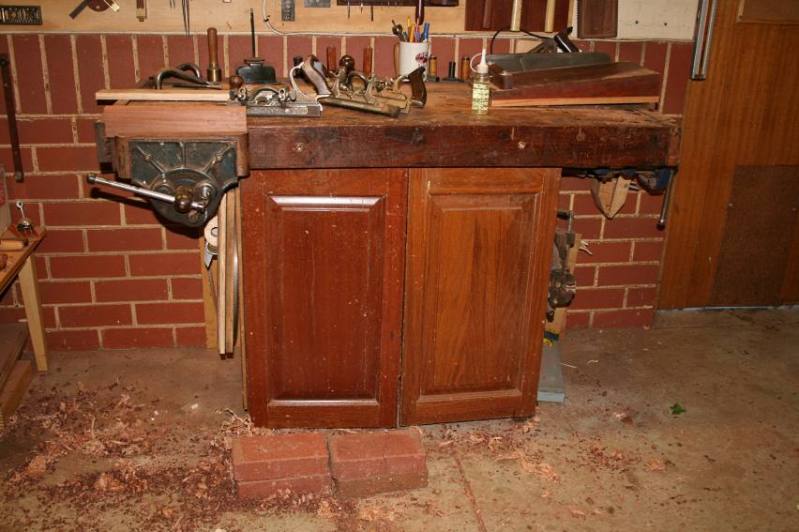
Interestingly,
this did feel so much better. It moved the focus of strength from my
arms and shoulders to my hips and legs (which is what one is taught
in karate). So the length of the legs was calculated for a bench top
of approximately 4" thickness (it will end up a little under
that), and the tenons were cut. Pictures of the legs tomorrow.
One
other point: One change begets other changes. With the lowering of
the bench, I shall need to build a new Moxon dovetail vise. The whole
idea of the Moxon is to raise the work up high. The existing vise was
built for a 34" high bench. To work with the same ease, the new
Moxon will need to work 4" higher. Hence a new, taller Moxon.
Regards
from Perth
Derek
January
2012