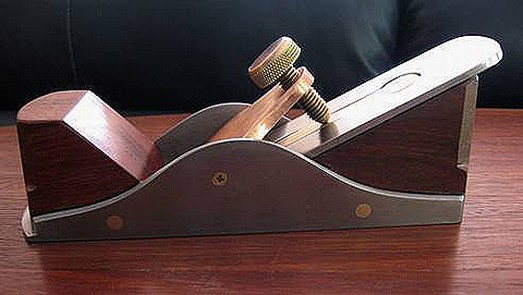
This could very well be called the LA plane that wasn’t. I started out with the best of intentions, wanting to join in the plane-building fun on the Porch. Ron (Hock) was damned nice in trying to find a blade for me after he had run out of stock. In the end me sent me (at my request) a 2” wide blade as I had set my sights on building a jointer. I know everyone was meant to build a bevel up smoother, but I had already done that, hadn’t I? And not so long ago.
I had this plan to build a jointer. Not just any jointer, but a 30” jointer! A Big Muvver!! And so I started to do this – but the blade was too short to use in a bevel up configuration for a plane this length. I was concerned that if I lowered the height of the body, then the plane would lose important rigidity. I re-cut the body and began building a bevel down plane.
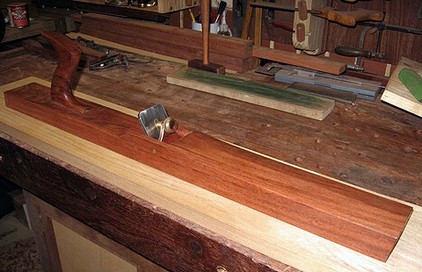
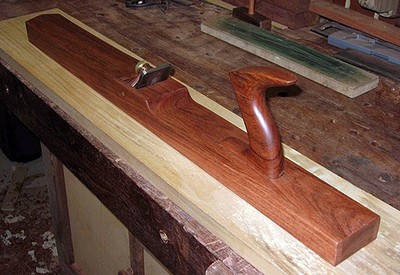
Well it has taken about 2 1/2 weekends to build this 30" jointer, but it is finally complete and I am very happy with it. I cannot believe that a plane this length can be so comfortable to use (note that a HNT Gordon Trying Plane is 17", a Stanley #7 is 22" and a Stanley #8 is 24" long). It turned out to be relatively light for laminated/solid Jarrah, just 2.25Kg (a tad under 5 lbs).
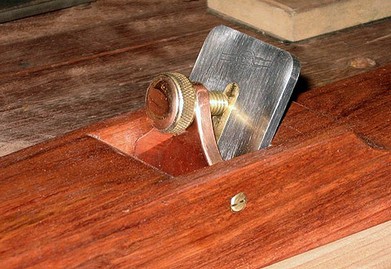
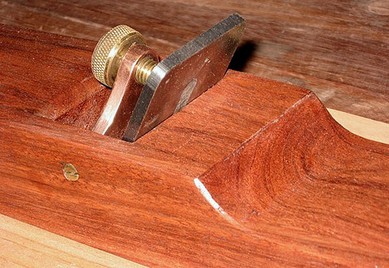
The iron, as anticipated, is a 3/16" Hock that I infilled the slot with brass so that I could use it as a single iron. The bed is 60 degrees. The lever cap is brass, nearly the last of the unusually pink stock I have. This is extremely hard metal. It is polished to direct shavings out of the mouth. The lever cap screw is capped with brass to match. I shaped the side screws out of brass bar.
The razee construction was inspired by some of Steve Knight's work, but overall I see the dominant influence of Terry Gordon
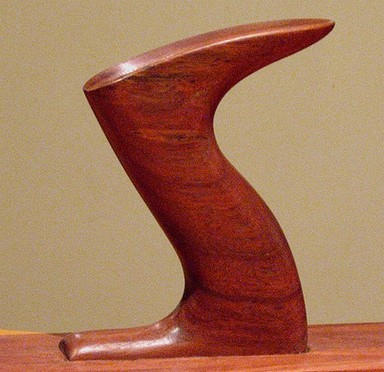
I often wondered what Terry's (HNT Gordon) planes would be like with a tote, so I added one.
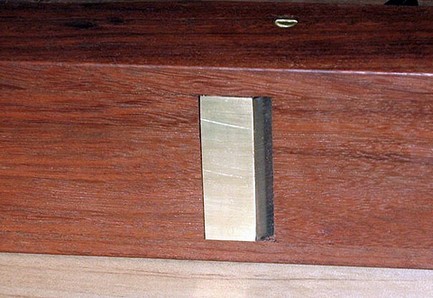
The mouth has a brass wear plate. It (the mouth) is very tight at present. I thought I would play with it like this first before opening it wider (as it is, I see this jointer taking fine shavings when truing edges of boards).
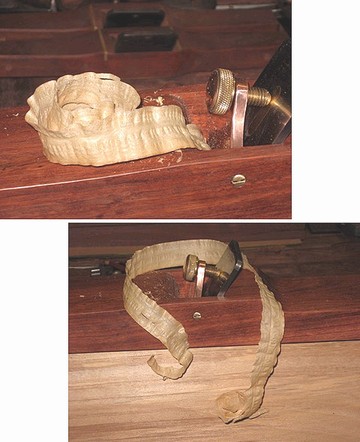
And, yes, it can make proper shavings. I only had a board of Karri Pine to hand, but it made light work with (in my impatience) a semi-sharp blade.
I plan to write up a few "how-tos" (would that make it "how three"?) on areas such as constructing a lever cap and cap screws without fancy shmancy equipment.
Hoping you enjoyed this as much as I ...
Derek Cohen
Perth, Australia
March 2007