
Apothecary chest – weekend one
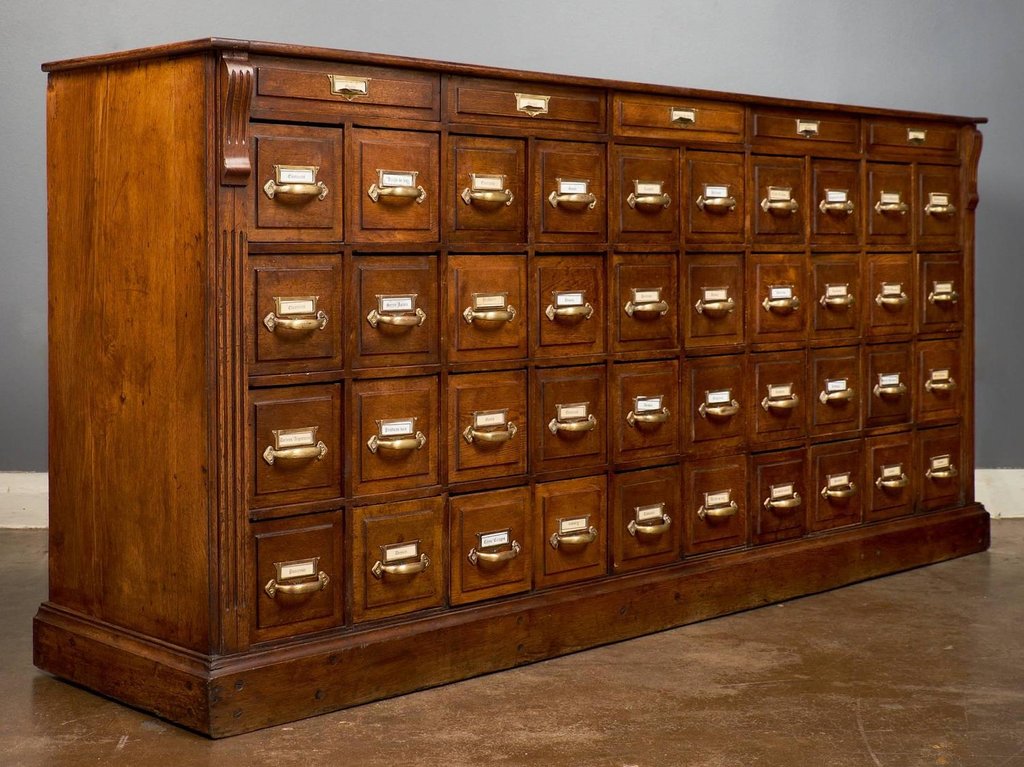
Lynndy and I were in Auckland, New Zealand recently for the wedding of her niece. We stayed with her brother and his wife. They have a wonderful home with some nice examples of arts and crafts furniture, one of which was an apothecary chest.
Examples of apothecary chests …
I
really love these pieces, and Lynndy especially has wanted one
forever. So the order was placed and a spot lined up in the entrance
hall.
The
design was mostly worked out in idle musing, and then I drew it up on
sheets of 6mm MDF (I like this since the sheets end up as a story
board and may be stored away more easily if needed at a later
date).
The orientation is vertical, rather than typically
horizontal, more along the lines of a Krenov-styled cabinet. I’ve
never built a Krenov-styled cabinet and, as far as I am aware, he
never built an apothecary chest!  In other words, this is a chest on a stand. As an aside, I am not
enamoured with the spindly legs of Krenov designs, and something with
substance is needed. More on this at a later date.
In other words, this is a chest on a stand. As an aside, I am not
enamoured with the spindly legs of Krenov designs, and something with
substance is needed. More on this at a later date.
The
chest will contain 24 drawers, in 6 rows (so 4 drawers across and 6
rows down) …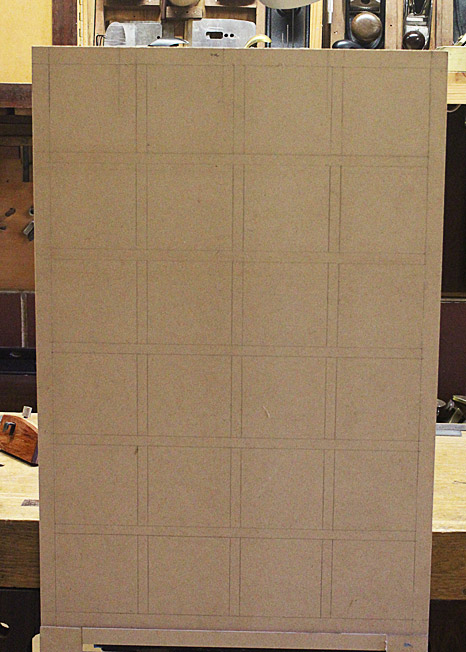
What
has changed in the drawing above is the rows will be made to
accentuate the vertical rather than the horizontal (by running the
blades/dividers down first). This is more work, but is should create
a different perspective.
I have never seen a curved apothecary
chest before, so this may be the first one …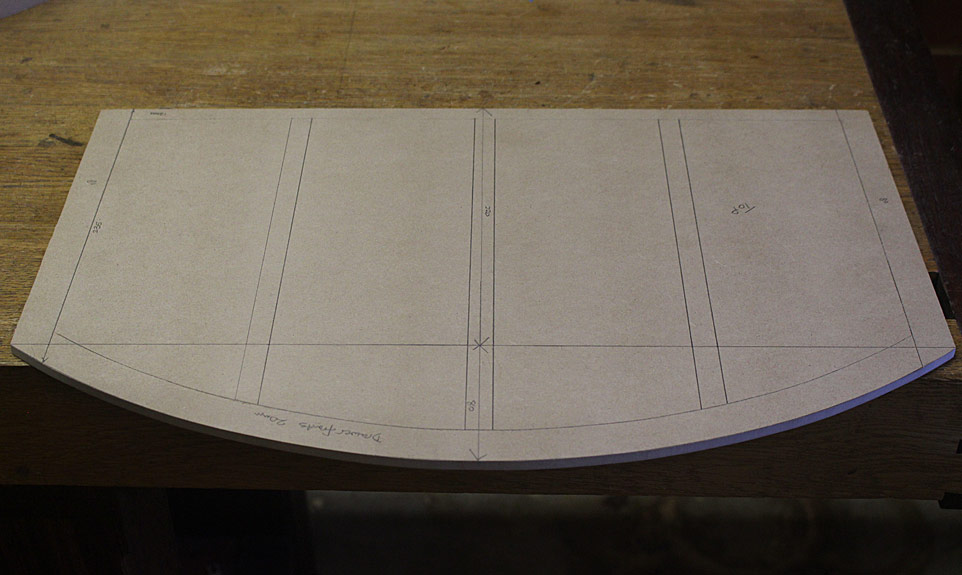
The
wood is another first for me – black walnut from the USA. My local
timber guy had a stack of 1” and 2” thick boards, all about
11-12” wide.
(For those who see metric measurements on
the plans and here is mentioned imperial sizing, be aware that this
is my common practice. The jointer-planer/thicknesser I have is
European, and metric. The hand tools, such as a plough plane, are
imperial).
The
boards are thicknessed a little oversize, glued up, and then taken to
final dimension with hand planes.
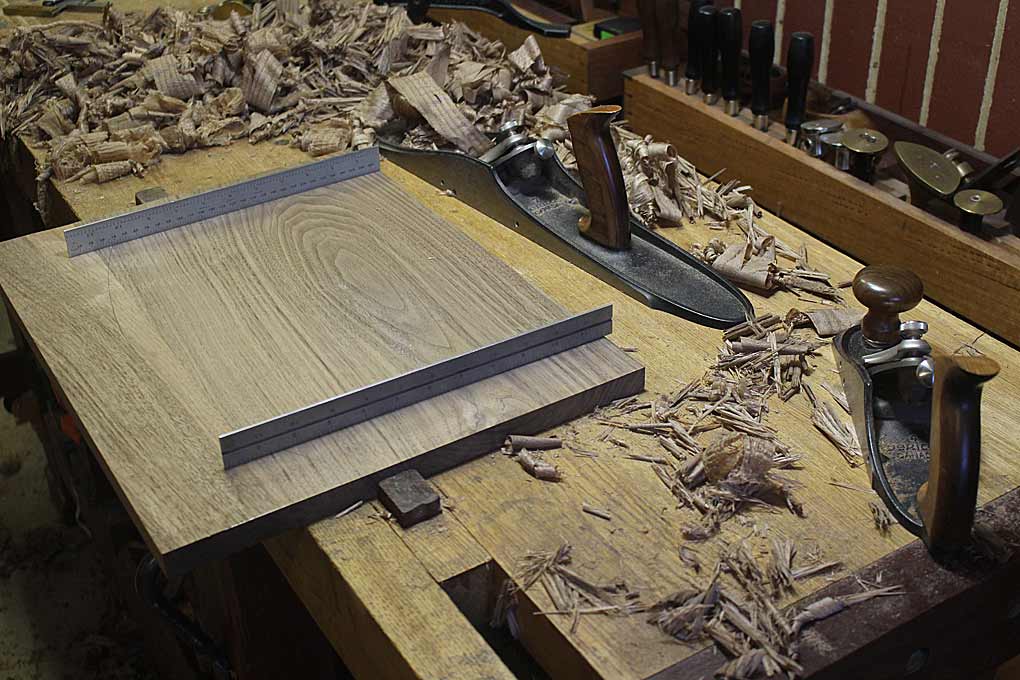
The
walnut is so easy to plane. I get why so many rave about working with
it.
Don’t you love it when the carcase parts are done.
These are all 20mm thick …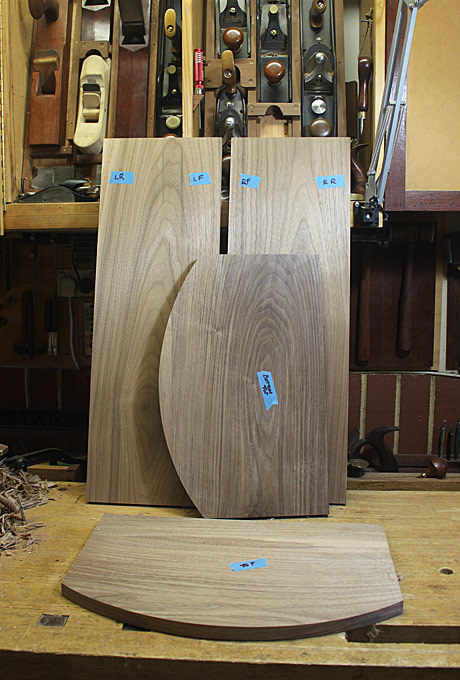
Starting
to put it together
Starting from the
bottom up, the side panels are left a little long as they will need
to be given a curved bevel to meld with the bottom panel …
The dovetails are in the ratio of 6:1 – I felt the
slightly extra wider base would add a little more
authority. 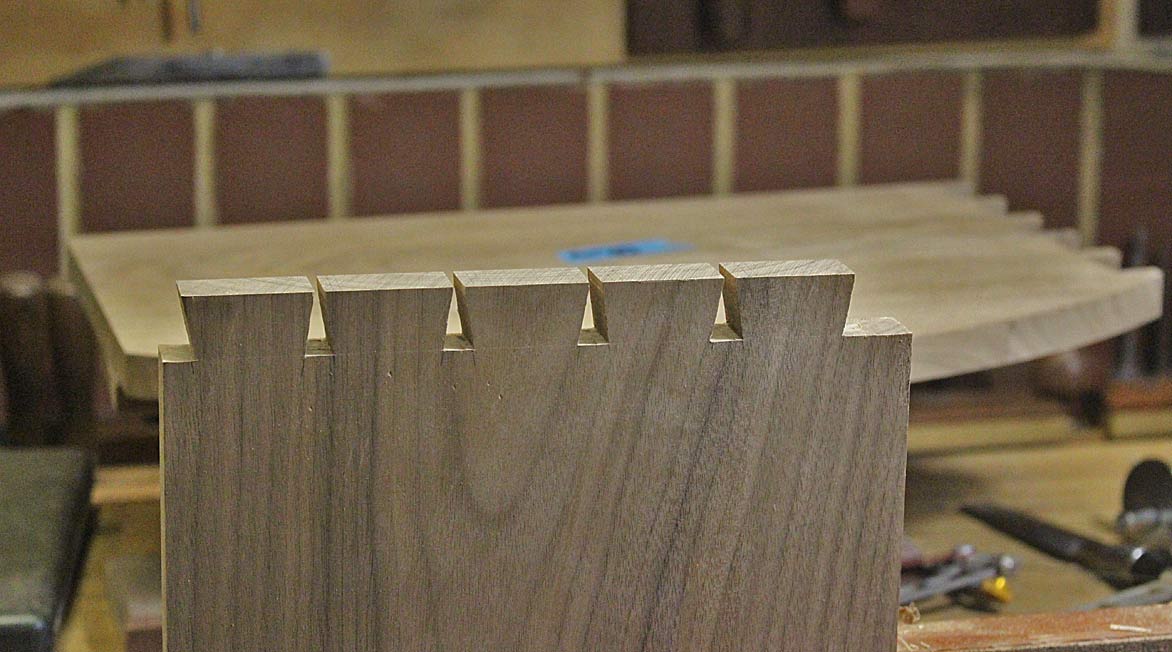
Here’s
the first completed corner. It is important that the joints are tight
(obviously) but also that they moved apart readily, since the cabinet
carcase will be pulled apart, put together, and pulled apart many
times as the drawer blades are measured and fitted ...
Note,
also, the area that will need to be bevelled away. This is
marked.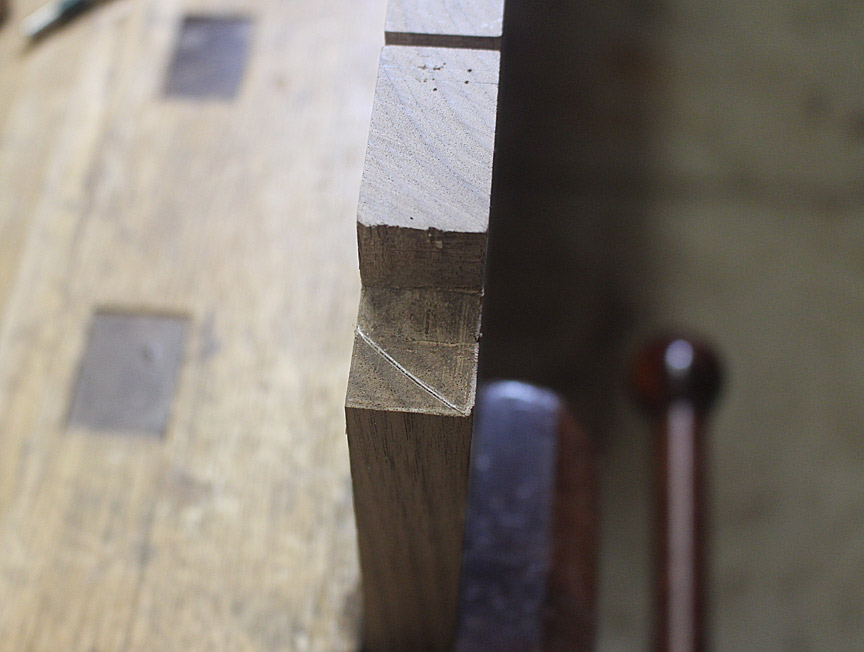
Now
the dimension of the bevel is taken the length of the panel …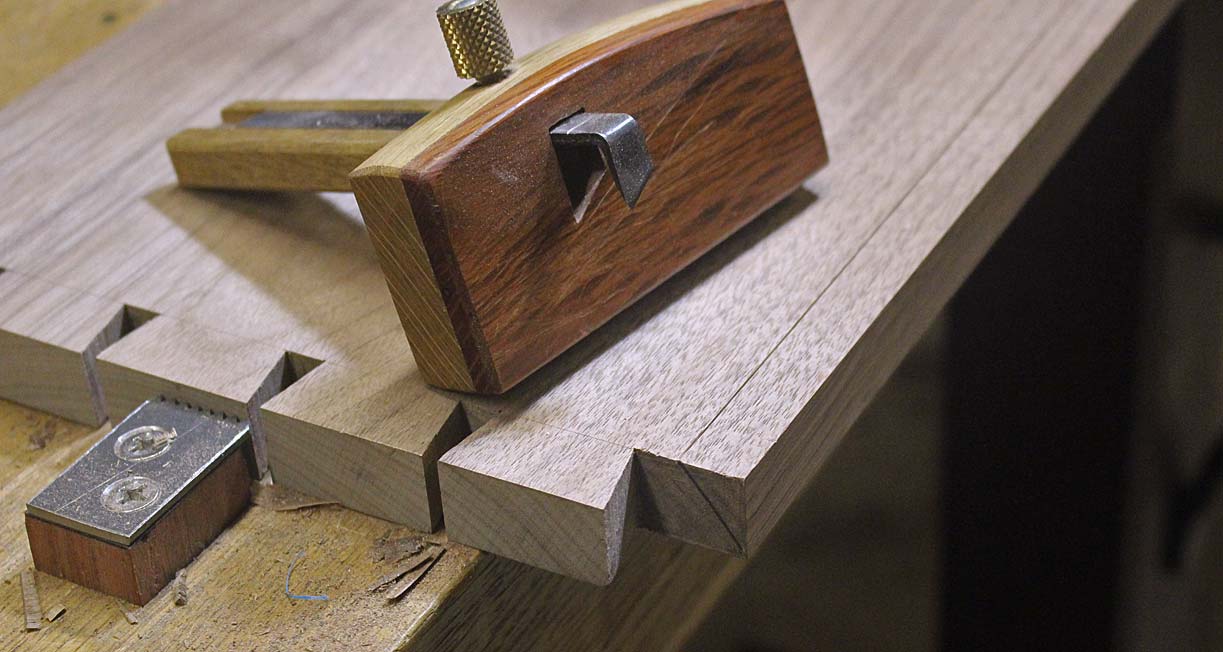
I
made up a template of the curve by grinding a piece of scrap steel
(chosen because it was lying around) …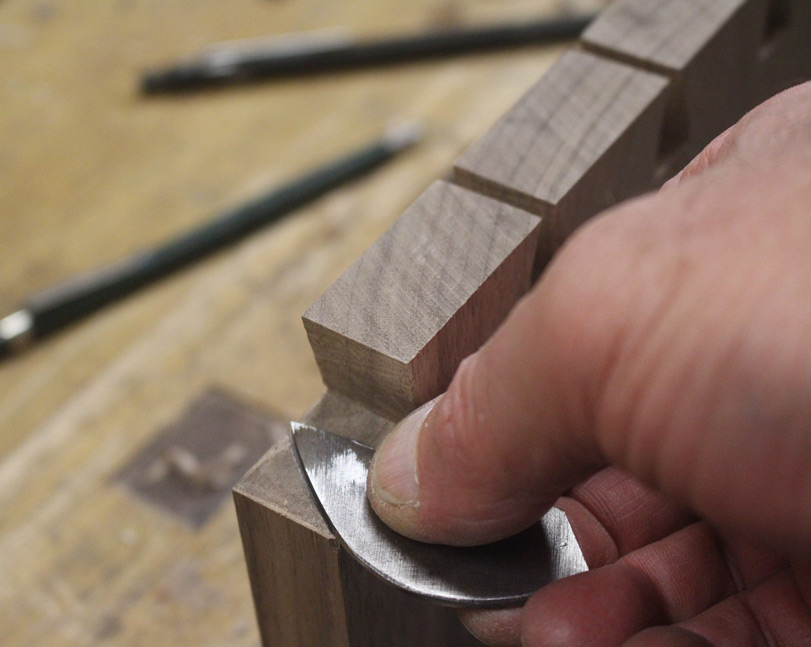
…
and the curve is transferred to the other end of the panel.
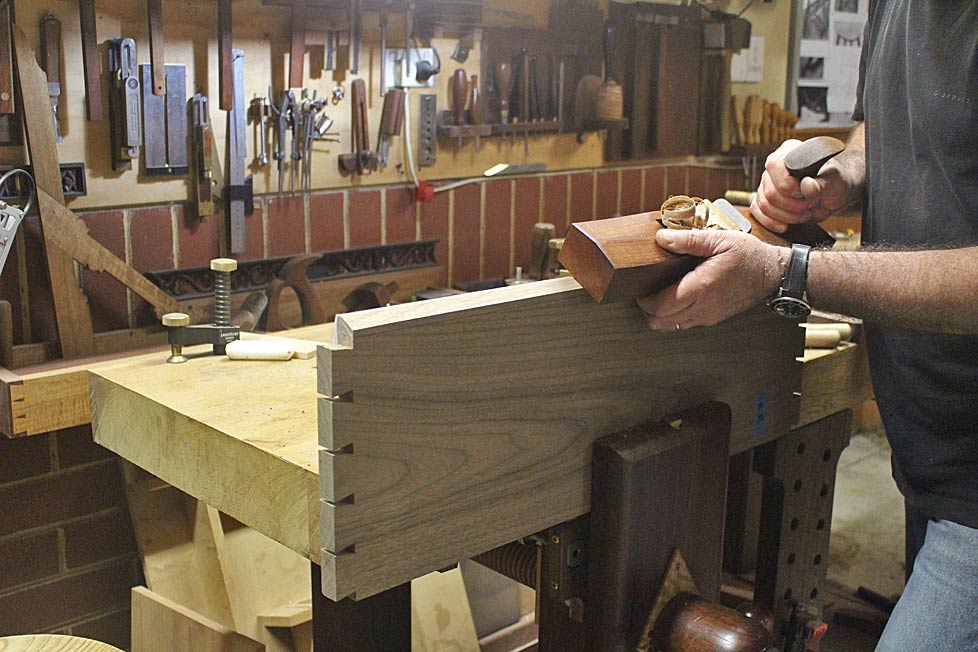
The
waste is planed away with, firstly, a jack plane (shop made)
…
...
and then a modified HNT Gordon trying plane …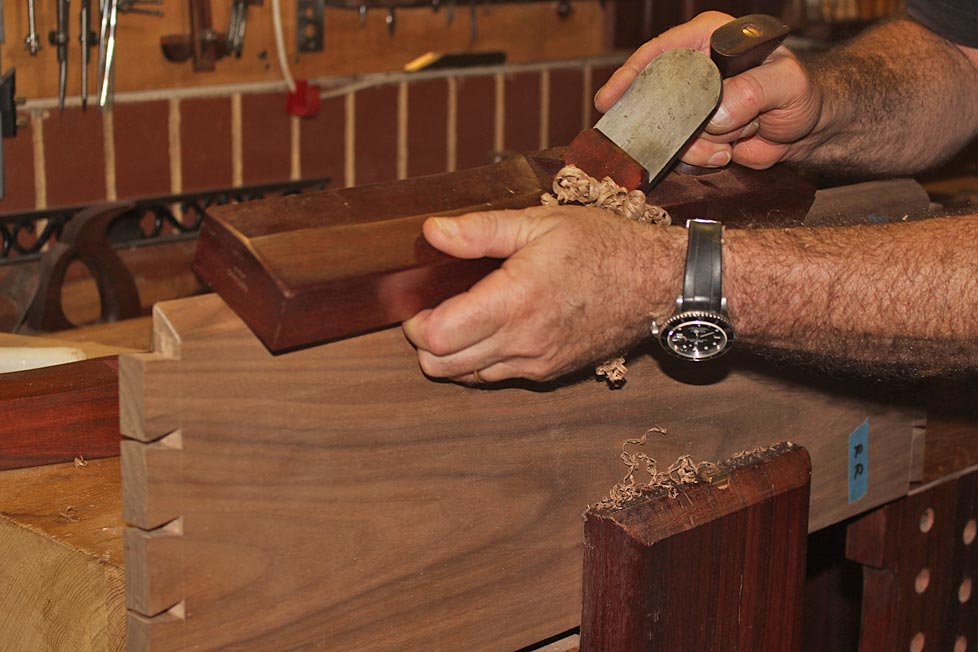
The
reason for the trying plane is to keep the sides straight. A jointer
plane could have substituted.
The final step here is to smooth
and fair the surface with a HNT Gordon mini smoother …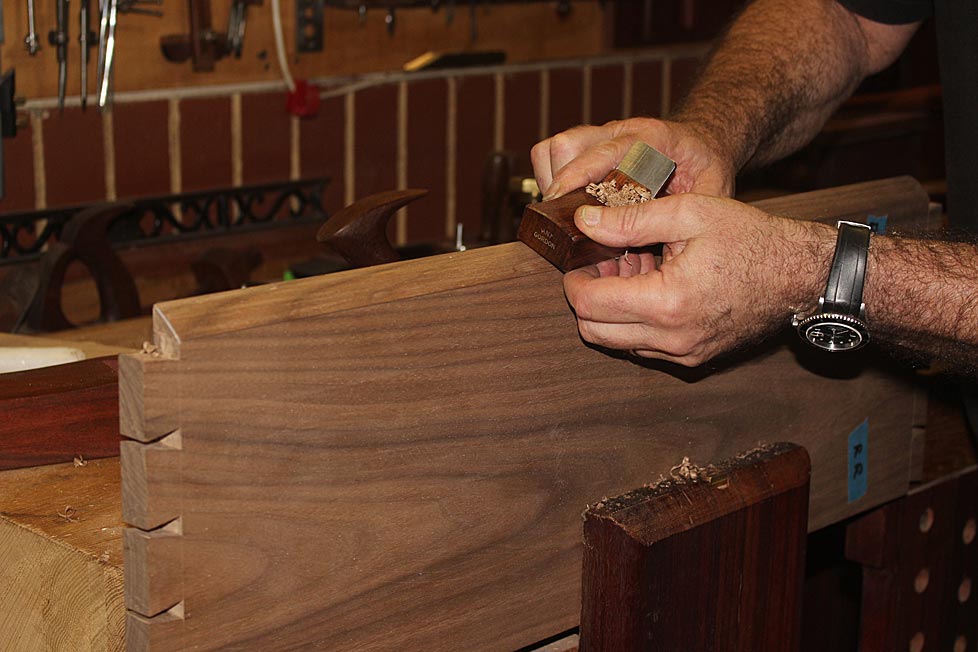
Finally,
we get to complete the basic carcase (the flash makes the walnut look
light, but it is dark in tone). the dimensions are 700mm high and
300mm deep (at the centre) …
Starting
the vertical drawer blades/dividers
These are made with merbau
as a secondary wood, with walnut facing …
Merbau
is from northern Queensland (some is imported from Papua New Guinea).
It is hard and heavy, and typically used in Oz for flooring or
outdoor furniture. I am using it because it is cheap and hard. As
cheap as pine and as dense and wear-resistant as jarrah.
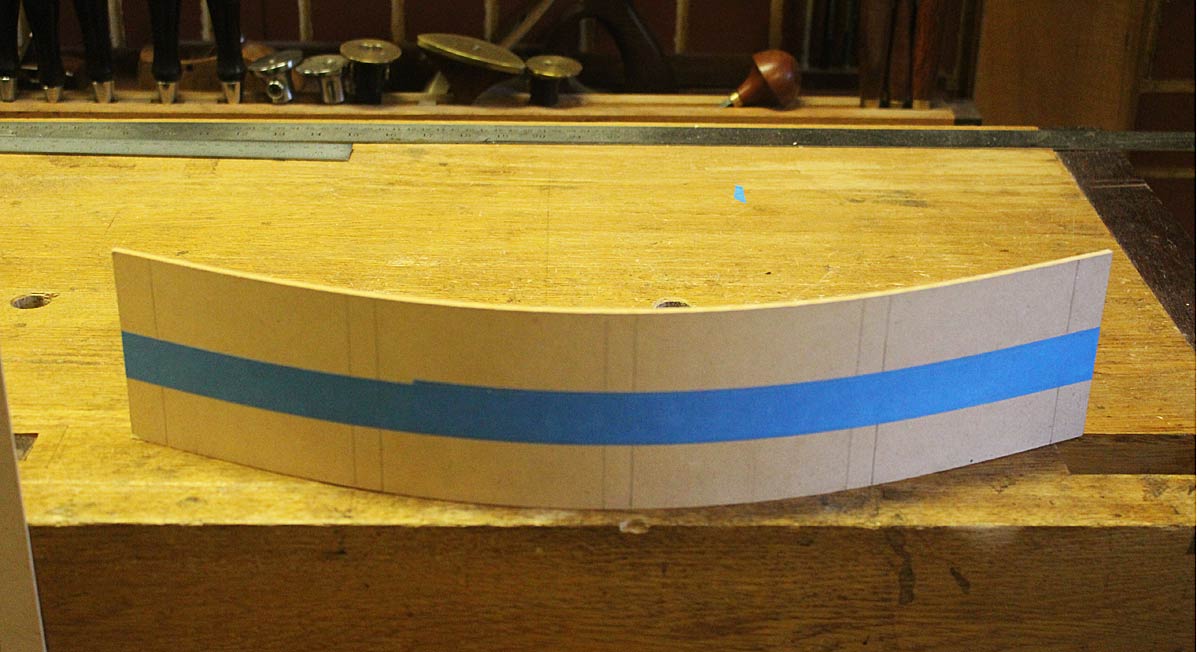
The
boards are glued together and bound with blue tape ..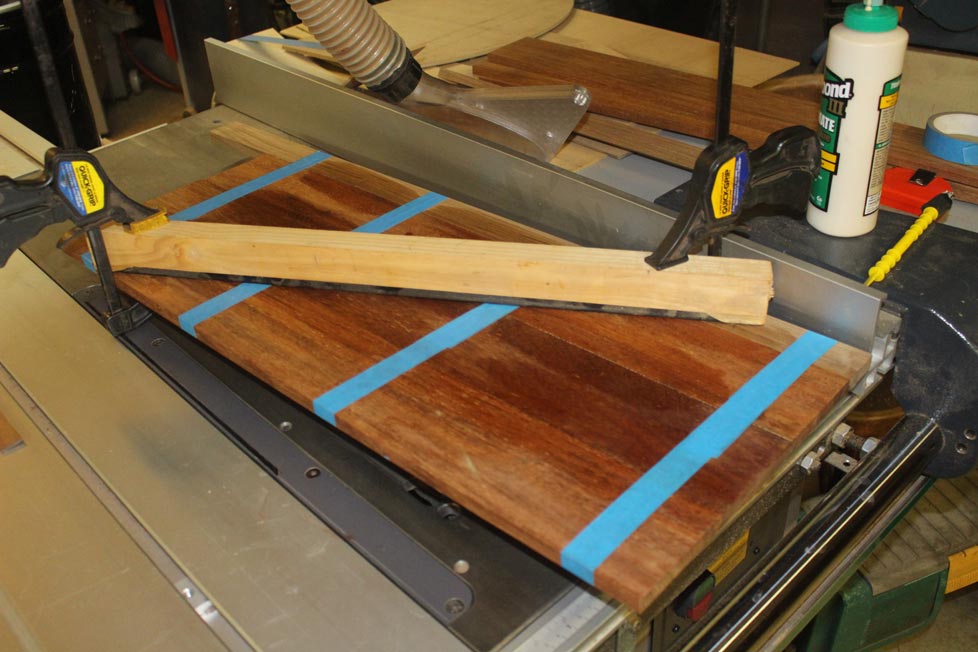
I
do have and do use parallel clamps ... but there is a time and a
place. The Besseys get used on a carcase, where you may need to apply
some pressure selectively to get parts into square, and keep them
there.
Panels, however, can become glue-starved with too
much pressure, especially when they are thin (I learned this the hard
way) ...
Three vertical dividers for now …
As
before, they are also slightly oversize and will be planed to
dimension to fit into 12mm wide dados.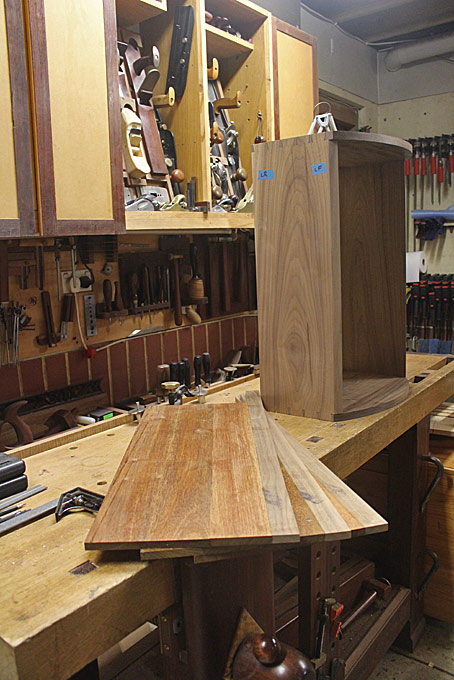
More
later.
Regards from Perth
Derek
April 2018